

TL;DR: AI Autopilots should be adopted through a digital transformation strategy, not by purchasing isolated tools. Organizations should identify stable, high-volume workflows with clear rules, strong data quality, accountable review, and rollback options; automate intelligence while retaining human judgement. Start with outsourced, outcome-based work, then decide whether to buy standardized capabilities or build around proprietary data and competitive advantages.
- Autopilots deliver completed outcomes, whereas Copilots assist human workers; this shifts software economics from seat licenses toward work units or outcome-based contracts.
- Automate repeatable intelligence tasks, but preserve human responsibility for strategy, ethics, taste, and other high-stakes judgement.
- Outsourced workflows are a practical starting point because their budgets, outcomes, and external delivery models are already established.
- Buy Autopilots for standardized, non-proprietary work; build custom systems when proprietary data or unique processes create competitive advantage.
- Map one workflow before adding another AI tool, evaluating frequency, risk, data quality, review ownership, and rollback options.
An AI autopilot only helps when the workflow is stable enough to delegate and important enough to monitor. Buying tools before defining the operating model creates faster confusion.
What this means in practice
- Add H2 headings for scanability.
- Add workflow selection checklist: frequency, risk, data quality, review owner, rollback path.
- Connect to digital transformation beyond isolated tools.
A mid-sized e-commerce retailer recently spent $12,000 annually on a premium SEO tool, yet they were still paying an agency $8,000 a month to actually execute the work. They didn’t have a software problem; they had a labor-to-tooling gap that traditional SaaS simply couldn’t bridge.
For 15 years at DATATIP, we have watched companies struggle with this exact friction: the cost of the software is negligible compared to the cost of the specialist required to operate it. We are now entering an era where the software doesn’t just assist the specialist—it replaces the function. This shift toward “Autopilots” is fundamentally changing the **AI digital transformation strategy** for every enterprise we advise.
## The Shift: Why Selling Tools is Yesterday’s Software Model
Traditional SaaS companies sell you a shovel and wish you luck with the digging. In the old model, the value was in the interface and the database. If you wanted to close your books, you bought QuickBooks; if you wanted to manage a warehouse, you bought an ERP.
Today, the ROI of software is being redefined by the delivery of the outcome itself. We are seeing a move from **Copilots (tools that assist humans)** to **Autopilots (systems that deliver finished work)**.
> The next generation of dominant software companies won’t sell licenses; they will sell completed transactions, filed taxes, and resolved support tickets.
When you buy an outcome, the efficiency of the underlying AI becomes the provider’s margin, not your overhead. For a CTO, this means shifting the budget from “Seat Licenses” to “Work Units,” a move that can **reduce operational overhead by 40-60%** in intelligence-heavy departments.
## Intelligence vs. Judgement: A Framework for Technical Leaders
To navigate this transition, you must distinguish between intelligence and judgement. This is the core of any pragmatic **enterprise AI implementation**.
**Intelligence** is the ability to follow complex rules, process data, and recognize patterns. Translating a clinical note into a standardized medical billing code or drafting a standard NDA is intelligence work. It is high-volume, repeatable, and increasingly autonomous.
**Judgement**, however, is about taste, ethics, and long-term strategy. Deciding whether to pivot your product line based on a competitor’s move or choosing when to incur technical debt to hit a market window requires human experience.
As a technical leader, your goal is to map your processes: automate the intelligence and preserve the human for the judgement. AI is now capable of handling roughly **80% of intelligence-based tasks** autonomously, leaving the remaining 20%—the high-stakes decisions—to your senior team.
## Software Engineering as the Leading Indicator for AI Adoption
Software engineering is the “canary in the coal mine” for AI transformation. Why? Because code is a logic-based system with clear rules, making it the perfect environment for AI intelligence to thrive.
At DATATIP, we’ve observed that over **50% of AI tool usage** globally is currently concentrated in software development. We aren’t just using AI for autocomplete; we are using agents to refactor legacy code, write unit tests, and debug entire modules.
This isn’t just a win for developers; it’s a blueprint for other industries. If AI can navigate the extreme complexity of a microservices architecture, it can certainly navigate the rules of insurance claims or accounting audits. The transition from “writing code” to “reviewing code” is the exact transition your accountants and claims adjusters will soon make.
## The ‘Outsourcing Wedge’: Where to Start Your AI Transformation
If you are looking for the highest **ROI of AI automation**, don’t start by firing your core team. Look at what you already outsource.
Outsourced tasks are the perfect “wedge” for AI for three reasons:
1. You have already accepted that the work can be done outside your four walls.
2. There is an existing budget line item that is easy to compare against an AI solution.
3. The relationship is already outcome-based, not hour-based.
Take **medical coding** or **insurance claims adjusting**. These are massive service industries where the work is essentially shopping across carriers or filling forms. By replacing a traditional service provider with an AI-native Autopilot, y
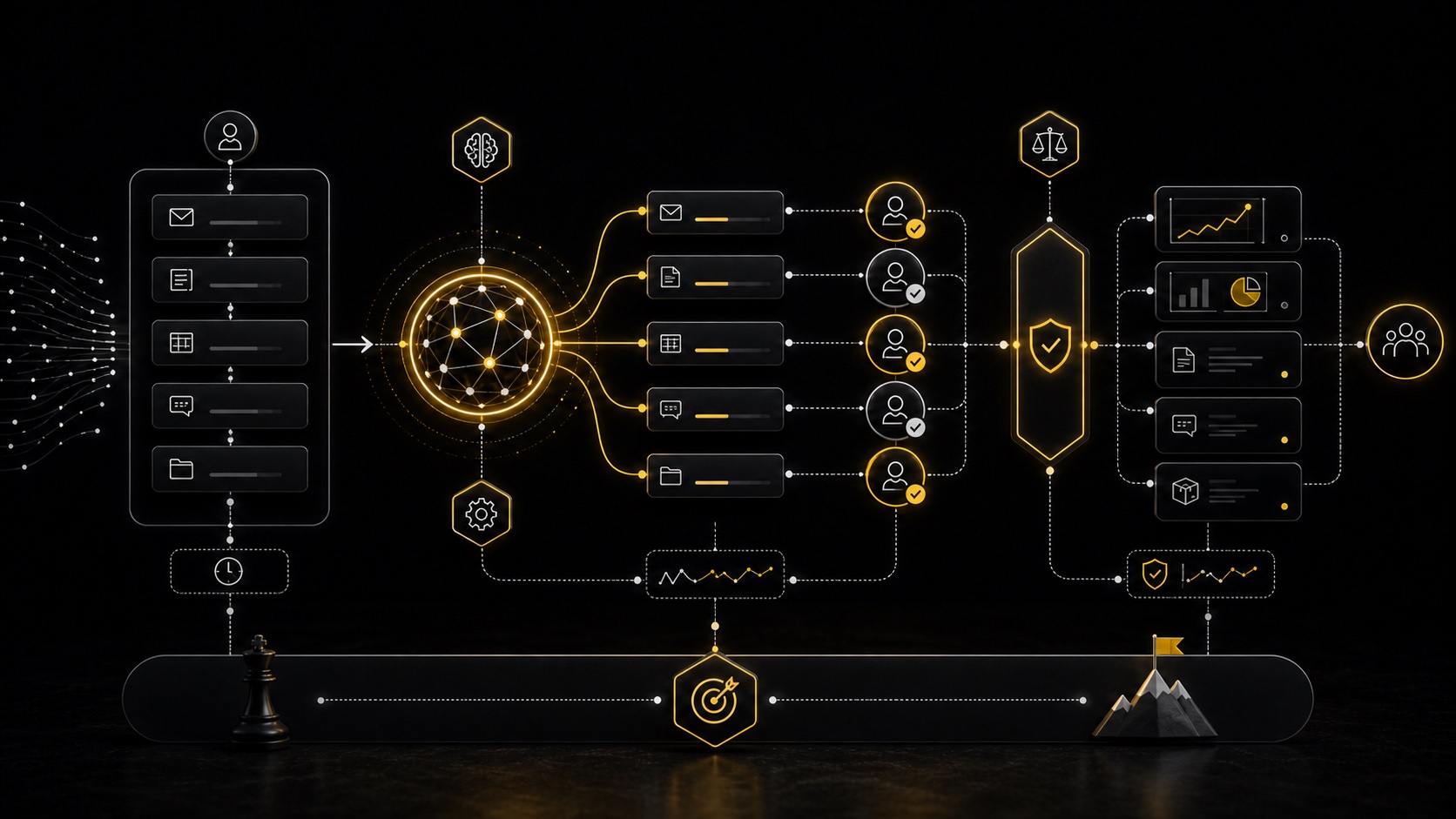
ou remove the human latency while keeping the outcome identical. This is where the first $100M in savings will be found in the next 24 months.
## Build vs. Buy: Navigating the Autopilot Landscape
One of the most common questions we face is whether to build a custom AI solution or buy an off-the-shelf Autopilot.
**Buy an Autopilot** when the task is standardized and non-proprietary. If you need to process standard NDAs or handle Tier-1 customer support, use a specialized AI provider. These companies compound data across thousands of clients, making their “intelligence” sharper than anything you could build in-house for a generic task.
**Build a custom AI-native system** when the work involves your proprietary data or a unique competitive advantage. If your e-commerce pricing engine relies on 10 years of specific customer behavior data, that is your moat. Building a custom layer on top of LLMs allows you to turn that data into a proprietary Autopilot that competitors cannot replicate.
## Actionable Strategy: Moving from Efficiency to Outcome-Based ROI
Digital transformation is no longer about making your employees faster; it is about restructuring how work gets done.
* **Audit your service spend:** Identify departments where you spend more on people (internal or external) than on tools.
* **Categorize by Intelligence Ratio:** High-intelligence, low-judgement tasks (like data entry or basic legal review) should be moved to Autopilots immediately.
* **Shift the Budget:** Move from per-user pricing to outcome-based contracts. If a vendor won’t guarantee an outcome, they aren’t an Autopilot.
—
### Frequently Asked Questions
### What is the difference between a Copilot and an Autopilot?
A Copilot is a tool that assists a human professional to be more productive (e.g., an AI that suggests code). An Autopilot is a system designed to deliver the final outcome directly (e.g., an AI that autonomously closes accounting books at month-end).
### How do I identify which tasks are ready for AI Autopilots?
Look for tasks with a high “intelligence-to-judgement” ratio. These are tasks that follow complex but consistent rules, such as medical billing, insurance claims processing, or basic contract drafting, where the rules are well-defined.
### Should I replace my outsourced partners with AI tools?
The most effective strategy is to replace traditional service providers with AI-native service providers. This allows you to swap a high-cost human contract for a lower-cost AI outcome without the organizational friction of internal restructuring.
### Will AI Autopilots eventually replace human judgement?
While the boundary of what AI can handle is expanding, true judgement—strategy, ethics, and high-level creative direction—remains a human domain. Autopilots handle the execution, allowing humans to focus on the “what” and “why” rather than the “how.”
> The real competitive advantage in the next five years won’t come from having the best tools, but from having the shortest distance between a business need and a completed outcome.
Next step
Map one workflow before adding another AI tool. Talk to DataTip.
Related Posts

AI Workforce Planning: Turn Productivity Into Capacity
BearingPoint's survey shows why AI productivity gains need workforce planning:…


ESPR Readiness: Map Supplier Data to Sector Milestones
Which ESPR milestone applies to your products? Map the relevant delegated act,…

ERP Implementation Costs: Transition vs. Delay
ERP benchmarks help frame transition risk, but they do not quantify the cost of…