

TL;DR: Charging customers for returns may reduce logistics expenses but can hurt conversion, repeat purchases, and customer loyalty, especially in fashion e-commerce and competitive European markets. The article recommends testing fees with specific audiences rather than relying on assumptions. Merchants can often reduce costs more safely through better sizing and product information, improved imagery, faster reverse logistics, and a painless return experience.
- A Shopify fashion store saw conversion fall 15% and repeat purchases decline 22% after introducing a return fee.
- Free returns are described as a baseline expectation for 76% of German online shoppers, while only 45% will pay for returns.
- Return fees can push customers toward competitors, particularly when rival retailers offer free returns.
- Detailed size guides, fit-focused reviews, improved images, and video can help prevent avoidable returns.
- Merchants should A/B test free versus paid returns and measure conversion, average order value, and repeat purchases.
Returns look like a logistics cost, but customers experience them as trust. The wrong return policy can protect margin on paper while quietly lowering conversion and repeat purchase.
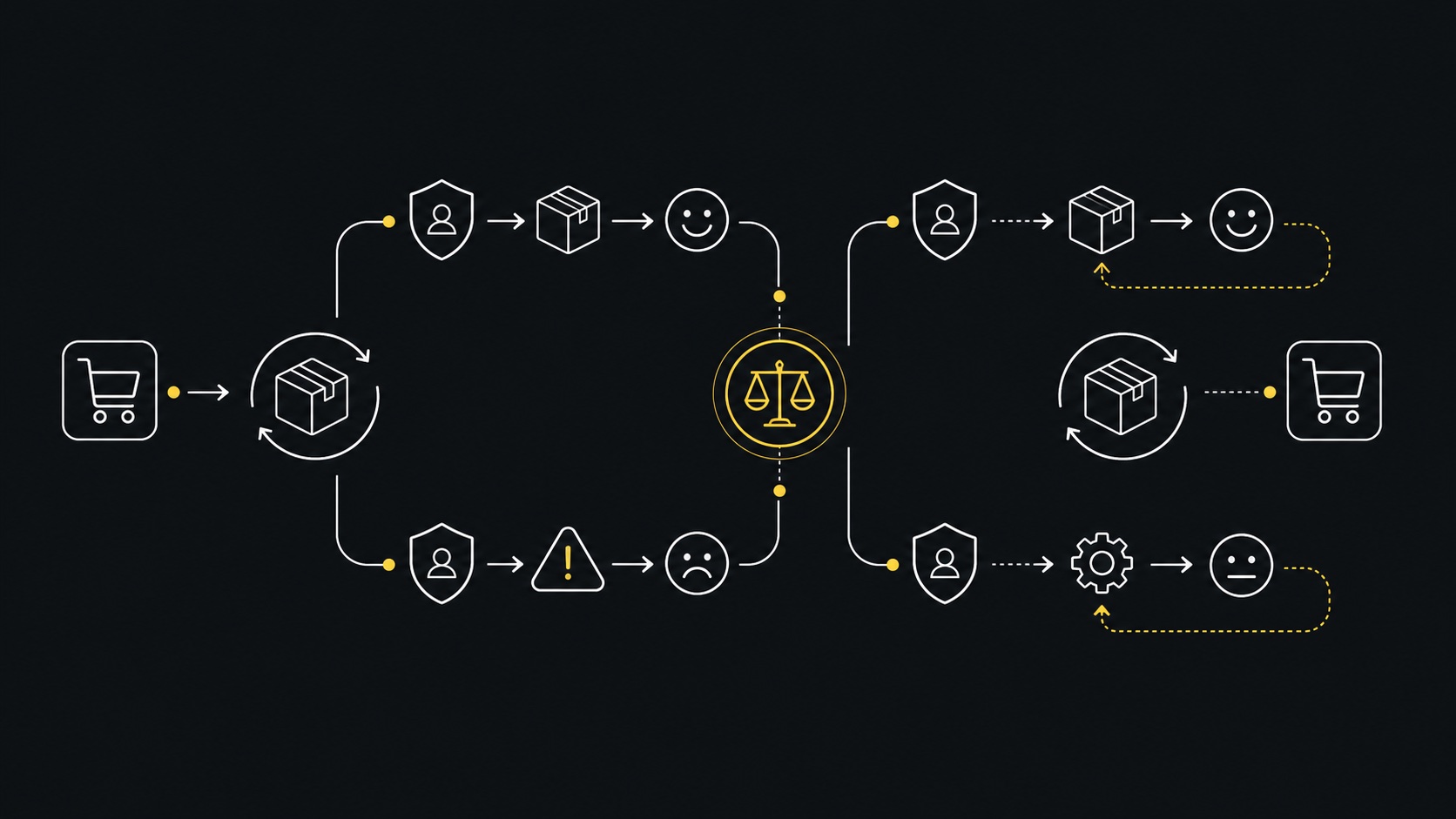
A strict or costly return policy can lower conversion rates by 10-20 %, depending on the segment. It also reduces repeat purchases. Customers who have a bad return experience are less likely to come back, and they’re more likely to tell others about it.
We’ve seen this play out with Shopify merchants who switched from free returns to paid returns. One fashion store we worked with saw their conversion rate drop by 15 % within a month of introducing a return fee. Repeat purchase rate fell by 22 %. The savings on return logistics didn’t come close to offsetting the revenue loss.
In a crowded European e-commerce market, even minimal changes to return policies can drive customers to competitors. If your biggest rival offers free returns and you don’t, you’re handing them your customers on a silver platter.
Think about the customer’s journey. They land on your product page, add an item to cart, and proceed to checkout. At the last step, they see your return policy. If it’s restrictive or costly, they might abandon the cart altogether. According to multiple studies, return policy clarity is one of the top three factors in cart abandonment for fashion e-commerce.
Even minimal changes to return policies can drive customers to competitors
The data from Germany suggests that even small fees can push shoppers to competitors. In a market where consumers have dozens of options for the same product, the return policy becomes a differentiator.
Consider this: a customer buys a dress from your store. It doesn’t fit. They check your return policy and see a fee. They then check your competitor’s policy – free returns. Which store do they choose next time? The choice is obvious.
This is why many European retailers absorb return costs as a cost of customer acquisition. The logic is simple: the cost of a return is lower than the cost of losing a customer forever.
We’re not saying you should never charge for returns. Some merchants make it work by being transparent about why they charge – for example, to keep product prices lower. But you need to test this with your specific audience. Run an A/B test on your return policy for a month and measure the impact on conversion rate, average order value, and repeat purchase rate.
If you’re on Shopify, you can use apps to manage return policies and track their impact on customer behaviour. The key is to have data, not just assumptions.
How to reduce return costs without charging customers
If you want to keep free returns but reduce the financial hit, focus on prevention. Better product information upfront reduces the likelihood of returns.
Start with size guides. A detailed size guide with measurements in centimetres, not just S/M/L, can reduce size-related returns by 20-30 %. Add customer reviews that mention fit – “this runs small” or “order a size up” – to give shoppers real-world feedback.
Improve product images. Show the item from multiple angles, on different body types, and in real-world settings. Video can also help. A 360-degree view or a short video of the garment in motion gives customers a better sense of fabric and fit.
Optimise your reverse logistics. Work with a logistics partner who can process returns quickly and cost-effectively. Some European logistics providers offer consolidated return centres where you can inspect, repackage, and resell items faster, reducing the time they sit in inventory.
Consider a return window that encourages faster decisions. A 14-day return window instead of 30 days can reduce the likelihood of items going out of season or being worn and returned. But be careful – EU law mandates a 14-day cooling-off period for online purchases, so you can’t go below that.
For more strategies on optimising your store’s performance, check out our guide on optimising Largest Contentful Paint for Shopify SEO success to reduce friction and improve conversions.
The strategic importance of the return experience
Your return policy is not just a logistics decision – it’s a customer experience decision. In a market where every click counts, the return experience can be the difference between a one-time buyer and a loyal customer.
If you’re building or scaling a Shopify store, the way you handle returns should be part of your conversion strategy, not an afterthought. Consider how you can optimise your product pages to reduce returns, or how you can streamline your return process to make it painless for customers. The best return policy is one that keeps customers coming back.
We’ve seen merchants who turned their return process into a competitive advantage. One Shopify store we know offers a prepaid return label and a 30-day return window with no questions asked. Their return rate is high – around 25 % – but their customer lifetime value is 40 % higher than the industry average. Customers trust them enough to buy more, more often.
For more insights on building a customer-centric e-commerce experience, check out our guide on building authority and traffic through Shopify blogging and learn how to drive traffic to your Shopify store with strategies that keep customers engaged.
Key Takeaways
- Free returns are a baseline expectation for 76 % of German online shoppers, especially in fashion.
- Only 45 % of shoppers will pay for returns, with lower-income customers being the least tolerant.
- Return policies directly affect conversions, loyalty, and purchase frequency – not just operational costs.
- Even small return fees can drive customers to competitors, especially in a crowded market.
- Absorbing return costs can be a strategic investment in customer retention, not just an expense.
- Prevention beats cure: better product descriptions, size guides, and images reduce return rates more effectively than charging fees.
Frequently Asked Questions
Why do German shoppers expect free returns so strongly?
The expectation comes from years of being conditioned by major retailers who offer free returns as standard. It’s now seen as a basic service, not a bonus.
Is charging for returns ever a good strategy?
It can work for high-margin, niche products where customers are less price-sensitive. But for most e-commerce stores, especially in fashion, the risk of losing customers outweighs the savings.
How can I reduce return costs without charging customers?
Improve product descriptions, size guides, and customer reviews. Better information upfront reduces the likelihood of returns. You can also optimise your reverse logistics to cut processing costs.
What is the EU law on returns for online purchases?
How do I test if my customers will accept return fees?
Run an A/B test on your Shopify store. Offer free returns to one segment and paid returns to another. Measure conversion rate, average order value, and repeat purchase rate over a month. Use the data to decide, not assumptions.
Next step
Review your returns policy before changing fees. Talk to DataTip.
Related Posts

Agentic Commerce: Why Your Data Infrastructure is the Real Bottleneck
Most e-commerce sites are optimized for human clicks, but AI agents are the new…


Shopify Inventory Is Capital. Sidekick Helps You Protect It.
Use Shopify Flows, Sidekick, purchase orders, transfers, barcode receiving, and…

No Source Content? Do Not Rewrite From a Guess.
When source content is missing from a rewrite brief, pause, request the…